NIS2 Compliance Automation: Which of the 10 Article 21 Requirements Can AI Agents Monitor Continuously
The NIS2 directive is now German law. The NIS2UmsuCG (NIS-2-Umsetzungs- und Cybersicherheitsstärkungsgesetz) passed in 2025, and enforcement begins October 2026. That’s not a distant deadline — it’s eight months away.
Most German “Important Entities” (wichtige Einrichtungen) sit at 60–75% readiness according to recent industry surveys. The gap isn’t knowledge. Every CISO knows what Article 21 demands. The gap is capacity.
The typical mid-market compliance team: 1–2 people. The frameworks they manage simultaneously: NIS2, GDPR, ISO 27001, and often TISAX or KRITIS on top. That’s four-plus regulatory frameworks for a team that can barely keep up with one.
AI agents don’t replace compliance officers. They replace the quarterly snapshot with continuous monitoring. The difference: instead of discovering a control failure during a scheduled review three months later, your GRC agent flags it within hours.
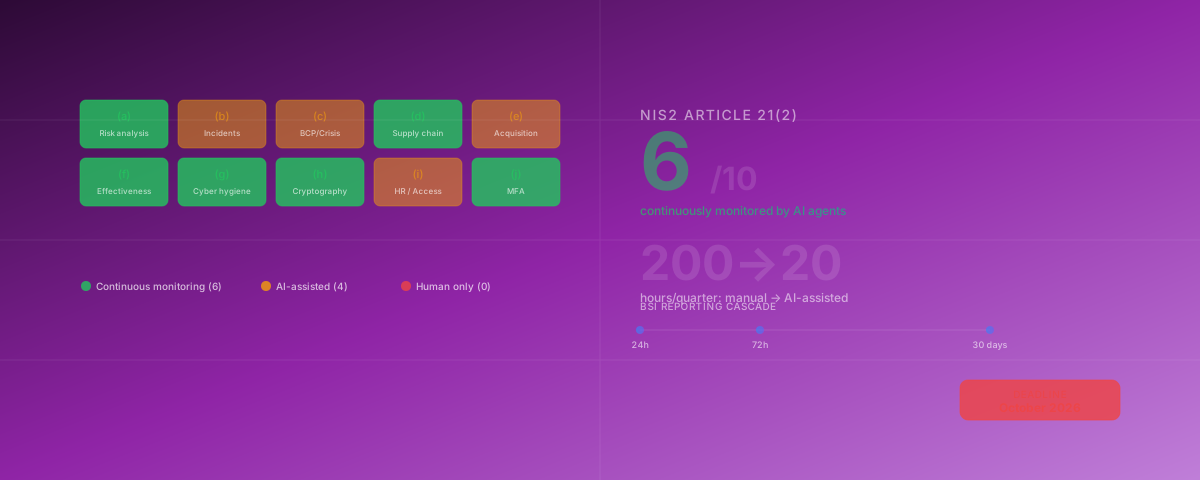
The Article 21 Automation Score
- 6 of 10 requirements → 🟢 Continuous AI monitoring
- 4 of 10 requirements → 🟡 AI-assisted (human decision required)
- 0 of 10 requirements → 🔴 Human-only
Here’s the complete mapping.
The Complete Article 21(2) Mapping
Article 21(2) of Directive (EU) 2022/2555 lists ten categories of cybersecurity risk-management measures. Each one maps differently to AI agent capabilities.
(a) Risk Analysis and Information System Security Policies
What NIS2 requires: Entities must establish policies for risk analysis and information system security, including a systematic approach to identifying, analyzing, and evaluating cyber risks across all critical systems.
What an AI agent does:
- Maintains a living risk register that updates automatically when new CVEs are published, incidents occur, or asset inventories change
- Auto-calculates risk scores using configurable frameworks (likelihood × impact, FAIR methodology, or custom matrices)
- Generates weekly risk trend reports showing score trajectories, not just snapshots
- Flags risks approaching defined thresholds before they breach tolerance levels
- Cross-references risks against BSI IT-Grundschutz Bausteine and ISO 27001 controls to identify coverage gaps
Automation Level: 🟢 CONTINUOUS MONITORING
ISO 27001:2022 Mapping: A.5.1 (Policies for information security), A.6.1 (Screening), A.8.2 (Information classification)
BSI IT-Grundschutz: ISMS.1 (Sicherheitsmanagement), ORP.1 (Organisation)
Agent Type: GRC Agent
What stays human: Risk appetite decisions, policy approval, board-level risk acceptance.
(b) Incident Handling
What NIS2 requires: Measures for incident prevention, detection, analysis, containment, response, and recovery. Under the NIS2UmsuCG, significant incidents must be reported to the BSI — early warning within 24 hours, full notification within 72 hours, final report within one month.
What an AI agent does:
- Triages SIEM alerts in real-time, reducing alert noise by correlating events across sources
- Enriches alerts with threat intelligence (MITRE ATT&CK mapping, IoC lookups, CVE context)
- Drafts incident reports in BSI-compliant format, pre-filling known fields
- Tracks the 24h / 72h / 1-month reporting cascade with countdown timers and escalation alerts
- Generates post-incident timelines from log data automatically
- Maintains an incident database with trend analysis across quarters
Automation Level: 🟡 AI-ASSISTED
Human makes escalation decisions. Human decides whether an incident is “significant” under §33 NIS2UmsuCG. Human approves BSI notifications. The agent prepares everything — the human decides and sends.
ISO 27001:2022 Mapping: A.5.24 (Information security incident management planning), A.5.25 (Assessment and decision on information security events), A.5.26 (Response to information security incidents)
BSI IT-Grundschutz: DER.2.1 (Behandlung von Sicherheitsvorfällen)
Agent Type: Incident Response Agent
(c) Business Continuity and Crisis Management
What NIS2 requires: Business continuity management including backup management, disaster recovery, and crisis management to ensure availability and restoration of systems after an incident.
What an AI agent does:
- Automates Business Impact Analysis (BIA) data collection by pulling system dependency maps, RTO/RPO values, and availability metrics
- Monitors backup job completion, retention compliance, and recovery test schedules
- Tracks DR plan currency — flags when plans reference decommissioned systems or outdated contacts
- Runs tabletop exercise scheduling and tracks completion rates
- Generates continuity readiness dashboards with real-time RTO achievement data
Automation Level: 🟡 AI-ASSISTED
BIA data collection and monitoring is automated. But crisis decisions — activating a DR plan, declaring a crisis, prioritizing recovery order during an actual incident — require human judgment. The Krisenstab decides, not the algorithm.
ISO 27001:2022 Mapping: A.5.29 (Information security during disruption), A.5.30 (ICT readiness for business continuity), A.8.13 (Information backup)
BSI IT-Grundschutz: DER.4 (Notfallmanagement)
Agent Type: Business Continuity Agent
(d) Supply Chain Security
What NIS2 requires: Security measures relating to the relationship between the entity and its direct suppliers or service providers, including vulnerability handling and cybersecurity requirements in contracts.
What an AI agent does:
- Maintains a vendor risk inventory with automated questionnaire distribution and response tracking
- Monitors vendor security posture continuously — SSL ratings, breach databases, dark web mentions, financial stability indicators
- Tracks fourth-party risk: who your vendors depend on (concentration risk in cloud providers, shared SaaS dependencies)
- Scans vendor contracts for required NIS2 clauses (incident notification obligations, audit rights, subcontractor controls)
- Alerts when a vendor appears in breach notifications (e.g., via Have I Been Pwned enterprise feeds or sector-specific ISACs)
Automation Level: 🟢 CONTINUOUS MONITORING
ISO 27001:2022 Mapping: A.5.19 (Information security in supplier relationships), A.5.20 (Addressing information security within supplier agreements), A.5.21 (Managing information security in the ICT supply chain)
BSI IT-Grundschutz: OPS.2.1 (Outsourcing für Kunden)
Agent Type: Vendor Risk Agent
What stays human: Vendor selection decisions, contract negotiations, relationship management, termination decisions.
(e) Security in Network and Information Systems Acquisition, Development, and Maintenance
What NIS2 requires: Security in the acquisition, development, and maintenance of network and information systems, including vulnerability handling and disclosure.
What an AI agent does:
- Integrates into CI/CD pipelines to enforce security gates (SAST, DAST, SCA scan results)
- Tracks vulnerability disclosure timelines — time from discovery to patch across all systems
- Monitors patch compliance across the asset inventory, flagging systems outside SLA
- Reviews change requests for security implications by cross-referencing affected systems with the risk register
- Maintains a vulnerability disclosure process tracker per ISO 29147
Automation Level: 🟡 AI-ASSISTED
Scanning and tracking is automated. But decisions about accepting vulnerability risk, prioritizing patches against business constraints, and approving architectural changes require human expertise. A security architect reviews — the agent tracks.
ISO 27001:2022 Mapping: A.8.25 (Secure development life cycle), A.8.8 (Management of technical vulnerabilities), A.8.9 (Configuration management)
BSI IT-Grundschutz: OPS.1.1.3 (Patch- und Änderungsmanagement), APP.6 (Allgemeine Software)
Agent Type: DevSecOps Agent
(f) Policies and Procedures for Assessing Effectiveness of Cybersecurity Risk-Management Measures
What NIS2 requires: Policies and procedures to assess the effectiveness of the cybersecurity risk-management measures — essentially, testing whether your controls actually work.
What an AI agent does:
- Runs automated control testing on schedule: Are firewall rules still configured correctly? Is logging still enabled on all critical systems? Are access reviews happening on time?
- Collects control evidence automatically from source systems (screenshots, config exports, log samples)
- Tracks control effectiveness metrics over time — pass/fail rates, mean time to remediate failed controls
- Generates audit-ready evidence packages mapped to specific Article 21(2) requirements
- Identifies control degradation trends before they become findings
Automation Level: 🟢 CONTINUOUS MONITORING
This is where AI agents shine brightest. Control effectiveness assessment is inherently a monitoring and data-collection task. The agent tests, measures, and reports. Humans interpret strategic implications and approve remediation plans.
ISO 27001:2022 Mapping: A.5.36 (Compliance with policies, rules, and standards), 9.1 (Monitoring, measurement, analysis, and evaluation)
BSI IT-Grundschutz: DER.3.1 (Audits und Revisionen)
Agent Type: Compliance Monitoring Agent
(g) Basic Cyber Hygiene Practices and Cybersecurity Training
What NIS2 requires: Basic cyber hygiene practices and cybersecurity training for all staff, with specific emphasis on management body awareness per Article 20(2).
What an AI agent does:
- Tracks training completion rates per department, role, and seniority — flags overdue personnel
- Monitors phishing simulation results: click rates, report rates, repeat offenders, trend lines
- Tracks Geschäftsführer/Vorstand training completion separately (Article 20(2) requires management body training specifically)
- Generates hygiene scorecards: password policy compliance, endpoint protection coverage, software update status
- Identifies departments with declining security awareness metrics for targeted intervention
Automation Level: 🟢 CONTINUOUS MONITORING
ISO 27001:2022 Mapping: A.6.3 (Information security awareness, education, and training), A.5.10 (Acceptable use of information and other associated assets)
BSI IT-Grundschutz: ORP.3 (Sensibilisierung und Schulung zur Informationssicherheit)
Agent Type: Security Awareness Agent
What stays human: Training content creation, in-person workshops, Betriebsrat coordination for monitoring activities.
(h) Policies and Procedures Regarding Use of Cryptography and, Where Appropriate, Encryption
What NIS2 requires: Policies and procedures on the use of cryptography and encryption to protect the confidentiality, authenticity, and integrity of data.
What an AI agent does:
- Maintains a complete cryptographic inventory: algorithms in use, key lengths, certificate expiry dates, protocol versions
- Monitors all public-facing SSL/TLS certificates — alerts 30/14/7 days before expiry
- Scans for deprecated algorithms (SHA-1, DES, RC4, TLS 1.0/1.1) across the environment
- Tracks crypto policy compliance: are all data-at-rest encryption requirements met? Are key rotation schedules followed?
- Monitors for quantum-readiness gaps as post-quantum cryptography standards mature (NIST FIPS 203/204/205)
Automation Level: 🟢 CONTINUOUS MONITORING
ISO 27001:2022 Mapping: A.8.24 (Use of cryptography)
BSI IT-Grundschutz: CON.1 (Kryptokonzept)
Agent Type: Security Assessment Agent
What stays human: Cryptographic policy decisions, algorithm selection for new systems, key management governance.
(i) Human Resources Security, Access Control Policies, and Asset Management
What NIS2 requires: Human resources security measures, access control policies, and asset management — covering the full lifecycle from onboarding through role changes to offboarding.
What an AI agent does:
- Runs automated access reviews: compares actual permissions against role-based access control (RBAC) baselines, flags deviations
- Monitors for orphaned accounts — detects when HR terminations don’t trigger corresponding AD/IdP deprovisioning
- Tracks asset inventory completeness: devices without owners, unmanaged endpoints, shadow IT indicators
- Correlates access patterns with job role data to detect privilege creep and excessive permissions
- Generates Joiner/Mover/Leaver compliance reports with SLA tracking
Automation Level: 🟡 AI-ASSISTED
Access reviews are automated in data collection and anomaly detection. But access decisions — should this person retain this permission? — require business context that humans provide. The Betriebsrat may also have co-determination rights (§87 BetrVG) over monitoring systems involved in access control.
ISO 27001:2022 Mapping: A.5.15 (Access control), A.5.16 (Identity management), A.5.18 (Access rights), A.6.1 (Screening), A.6.5 (Responsibilities after termination), A.5.9 (Inventory of information and other associated assets)
BSI IT-Grundschutz: ORP.2 (Personal), ORP.4 (Identitäts- und Berechtigungsmanagement)
Agent Type: IAM Governance Agent
(j) Use of Multi-Factor Authentication or Continuous Authentication Solutions
What NIS2 requires: Use of multi-factor authentication (MFA) or continuous authentication solutions, secured voice/video/text communications, and secured emergency communication systems where appropriate.
What an AI agent does:
- Monitors MFA enrollment rates across all identity providers — flags users and service accounts without MFA
- Detects MFA bypass events and fallback authentication usage
- Tracks MFA method strength: distinguishes between SMS (weak), TOTP (acceptable), and FIDO2/passkeys (strong)
- Monitors for authentication anomalies: impossible travel, new device registrations, brute force attempts
- Generates MFA coverage reports per system, department, and user type (internal, external, privileged)
Automation Level: 🟢 CONTINUOUS MONITORING
ISO 27001:2022 Mapping: A.8.5 (Secure authentication)
BSI IT-Grundschutz: ORP.4 (Identitäts- und Berechtigungsmanagement)
Agent Type: IAM Governance Agent
What stays human: MFA policy exceptions, method selection strategy, user experience trade-offs.
Summary: All 10 Requirements at a Glance
| Art. 21(2) | Requirement | Automation Level | Agent Type | Automated | Human |
|---|---|---|---|---|---|
| (a) | Risk analysis & IS policies | 🟢 CONTINUOUS | GRC Agent | Risk scoring, trend monitoring, threshold alerts | Risk appetite, policy approval |
| (b) | Incident handling | 🟡 AI-ASSISTED | Incident Response Agent | Triage, enrichment, report drafting, deadline tracking | Escalation decisions, BSI notification approval |
| (c) | Business continuity & crisis mgmt | 🟡 AI-ASSISTED | Business Continuity Agent | BIA data collection, backup monitoring, DR plan tracking | Crisis decisions, recovery prioritization |
| (d) | Supply chain security | 🟢 CONTINUOUS | Vendor Risk Agent | Vendor monitoring, breach alerts, contract scanning | Vendor selection, contract negotiation |
| (e) | Acquisition, development, maintenance security | 🟡 AI-ASSISTED | DevSecOps Agent | Pipeline security gates, patch tracking, vuln monitoring | Risk acceptance, architecture decisions |
| (f) | Effectiveness assessment | 🟢 CONTINUOUS | Compliance Monitoring Agent | Control testing, evidence collection, trend analysis | Remediation strategy, audit response |
| (g) | Cyber hygiene & training | 🟢 CONTINUOUS | Security Awareness Agent | Training tracking, phishing metrics, hygiene scores | Content creation, Betriebsrat coordination |
| (h) | Cryptography & encryption | 🟢 CONTINUOUS | Security Assessment Agent | Cert monitoring, crypto inventory, algorithm scanning | Policy decisions, algorithm selection |
| (i) | HR security, access control, assets | 🟡 AI-ASSISTED | IAM Governance Agent | Access reviews, orphan detection, privilege creep alerts | Access decisions, Betriebsrat compliance |
| (j) | MFA / continuous authentication | 🟢 CONTINUOUS | IAM Governance Agent | MFA coverage monitoring, bypass detection, method tracking | Policy exceptions, method strategy |
The Compliance Gap Reality
Manual vs. AI-Monitored Compliance
| Metric | Manual Process | AI-Monitored |
|---|---|---|
| Assessment frequency | Quarterly | Continuous |
| Hours per quarter (Article 21) | ~200 hours | ~20 hours (review + approve) |
| Control failure detection | Next scheduled review (up to 90 days) | Hours |
| Evidence collection for audit | 2–4 weeks scramble | Always current |
| Staff required | 2–3 FTE dedicated | 0.5 FTE oversight |
| Framework coverage | Usually 1–2 at a time | All simultaneously |
The math is straightforward. A 90% reduction in compliance monitoring time doesn’t mean you fire your compliance team. It means your 1.5-person team can actually cover NIS2 + GDPR + ISO 27001 + TISAX without burning out.
What AI agents will never do:
- Strategic risk decisions — the Geschäftsführung defines risk appetite, not an algorithm
- Betriebsrat engagement — works council coordination for monitoring tools requires human negotiation under §87 BetrVG
- Board presentations — the CISO presents to the Vorstand, the agent prepares the data
- Regulatory interpretation — when the BSI issues new guidance, humans interpret and adapt
- Audit defense — when the auditor asks “why did you accept this risk?”, a human answers
Implementation Timeline for October 2026
Phase 1: Foundation (Now – April 2026)
Deploy GRC and Compliance Monitoring agents. Complete an AI-assisted gap assessment against all ten Article 21(2) requirements. Establish baselines for every control. Output: Complete gap analysis with prioritized remediation roadmap.
Phase 2: Remediation (April – July 2026)
Address identified gaps with AI-assisted tracking. Agents monitor remediation progress, flag stalled items, and re-test controls as fixes are implemented. Deploy Vendor Risk and Incident Response agents. Output: 80%+ control implementation with evidence.
Phase 3: Evidence & Readiness (July – September 2026)
Automated evidence collection running across all ten requirement categories. Pre-audit readiness checks. Simulate BSI reporting workflows end-to-end. Train management body per Article 20(2). Output: Audit-ready evidence packages, tested incident response workflows.
Phase 4: Continuous Compliance (October 2026 →)
Enforcement begins. You’re not scrambling — you’re monitoring. Continuous compliance, not checkbox compliance. Agents run 24/7; your team reviews dashboards and handles exceptions. Output: Living compliance posture, not a static report.
⚠️ Key Deadline: The NIS2UmsuCG enforcement date of October 2026 is not a “be compliant by” date — it’s a “be compliant on” date. The BSI can audit from day one. Start now.
BSI Reporting Integration
The NIS2 reporting cascade is one of the most operationally demanding requirements. Here’s how an Incident Response Agent handles it:
Within 24 hours — Early Warning (Frühwarnung) The agent detects the incident via SIEM correlation, classifies severity, and drafts an early warning in BSI-compliant format. It pre-fills: incident category, affected systems, estimated impact scope, initial IoCs. A human reviews, confirms classification as “significant” (erheblicher Sicherheitsvorfall), and approves submission to the BSI portal.
Within 72 hours — Incident Notification (Meldung) The agent compiles the full notification: updated impact assessment, attack vector analysis (MITRE ATT&CK mapped), affected service scope, cross-border impact indicators, containment status. It pulls data from ticketing systems, SIEM logs, and threat intel feeds automatically. Human reviews, adds strategic context, approves.
Within 1 month — Final Report (Abschlussbericht) The agent generates a comprehensive timeline from first indicator to full containment. It compiles: root cause analysis data, remediation actions taken, lessons learned (mapped back to Article 21 controls), and effectiveness metrics of the response. This becomes both BSI-compliant and internally useful for the next management review.
The difference: without an agent, each of these reports takes 4–8 hours of manual compilation under extreme time pressure. With an agent, the human spends 30–60 minutes reviewing and approving pre-generated content.
From Quarterly Snapshots to Continuous Compliance
NIS2 Article 21 isn’t asking for anything revolutionary. Risk management, incident handling, business continuity, supply chain security — these are established disciplines. What’s new is the scope (far more entities covered), the accountability (management body personal liability under Article 20), and the reporting speed (24-hour initial notification).
AI agents address the operational reality: too many requirements, too few people, too little time. Six of ten Article 21(2) requirements can run under continuous automated monitoring. The remaining four get AI-assisted workflows that reduce manual effort by 80–90%.
The result isn’t compliance theater. It’s a compliance team that actually sleeps at night.
See the NIS2 gap analysis live with sample data from a German manufacturer → Try the Compliance Agent demo
Need help with this?
We help enterprise security teams implement what you just read — from strategy through AI-powered automation. First strategy session is free.