The Real Cost of a Security Hire in Germany 2026: Why CISOs Are Turning to AI Augmentation
You need to grow your security team. You’ve known it for months. The backlog is growing, compliance deadlines are approaching, and your two senior analysts are stretched thin across three workstreams each.
So you open a headcount request. And then reality hits.
In Germany, hiring a security professional isn’t just expensive — it’s slow, bureaucratic, and increasingly impossible. This article lays out the real numbers, no sugarcoating, and makes the case for a model most CISOs are already quietly adopting: AI augmentation.
What Security Talent Actually Costs in Germany (2026)
Let’s start with base salaries. These are market rates for 2026 based on compensation data from Hays, Michael Page, StepStone, and Bitkom’s annual IT salary survey:
| Role | Salary Range (National) | Munich Adjustment |
|---|---|---|
| SOC Analyst, Junior | €55,000 – €65,000 | €63,000 – €78,000 |
| SOC Analyst, Senior | €70,000 – €85,000 | €80,500 – €102,000 |
| Security Architect | €85,000 – €110,000 | €97,750 – €132,000 |
| GRC Manager | €75,000 – €95,000 | €86,250 – €114,000 |
| AppSec Engineer | €80,000 – €100,000 | €92,000 – €120,000 |
| CISO | €120,000 – €180,000 | €138,000 – €216,000 |
Munich commands a 15–20% premium over the national average. Frankfurt and Stuttgart aren’t far behind. Berlin remains slightly below average for senior roles but is catching up fast, especially in fintech and healthtech security.
These numbers look manageable on a spreadsheet. They’re not the problem. The problem is everything that comes on top.
The True Cost: Why Your €85K Hire Actually Costs €140K+
Salary is roughly 60% of what a security hire actually costs you. Here’s the full picture for a Senior SOC Analyst at €85K base:
Step 1: Employer Overhead — +30%
Sozialversicherung (Arbeitgeberanteil), Berufsgenossenschaft, Umlagen — the standard German employer burden adds approximately 30% on top of gross salary. For an €85K hire, that’s €25,500/year in mandatory contributions alone.
Running total: €110,500/year
Step 2: Recruiting Fees — 20–25% of Annual Salary
Unless you have an internal talent acquisition team that specializes in cybersecurity (you don’t), you’re paying an external recruiter. The standard contingency fee for security roles in Germany is 20–25% of first-year salary. For our €85K analyst: €17,000–€21,250 — paid once, but it hurts.
Running total: €127,500–€131,750 (Year 1)
Step 3: Onboarding & Ramp-Up — 3 to 6 Months
A senior hire doesn’t walk in productive on day one. They need to learn your environment, your tooling, your processes, your threat landscape, your internal politics. Industry data consistently shows 3–6 months to full productivity for mid-to-senior security roles.
During ramp-up, they’re operating at maybe 40–60% capacity. That’s 2–4 months of effective output lost. At a fully loaded monthly cost of ~€9,200, that’s €18,400–€36,800 in reduced productivity.
Step 4: Training & Certifications — €5,000–€10,000/year
SANS courses run €6,000–€8,000 each. OSCP prep and exam: ~€2,500. Cloud security certifications, conference attendance, ongoing education — budget €5,000–€10,000 annually to keep your people current. If you don’t, they leave for someone who will.
Step 5: Tooling & Licenses — €3,000–€8,000/year
Per-seat licenses for SIEM, EDR, vulnerability scanners, threat intelligence platforms, ticketing systems. Each analyst needs their own access. Budget €3,000–€8,000/year depending on your stack.
Add it all up for Year 1:
Year 1 total cost for a Senior SOC Analyst (€85K base):
- Salary + overhead: €110,500
- Recruiting: €17,000–€21,250
- Ramp-up productivity loss: €18,400–€36,800
- Training: €5,000–€10,000
- Tooling: €3,000–€8,000
Total: €153,900 – €186,550
Ongoing annual cost (Year 2+): €118,500 – €128,500
That €85K hire? It’s a €154K–€187K commitment in Year 1, settling to €119K–€129K annually thereafter. For a Security Architect at €110K base, you’re looking at Year 1 costs north of €220K.
And this assumes you actually find someone.
The Timeline Problem: 7–15 Months from Need to Productivity
Here’s where German hiring gets truly painful. The timeline from “we need this role” to “this person is delivering value” is staggering:
Month 0: Headcount approved. Job description written. Posted on LinkedIn, StepStone, XING.
Months 1–2: Applications trickle in. Most are unqualified. Your HR team doesn’t know how to screen for security skills. You’re reviewing CVs between incident responses.
Months 2–4: Interview rounds. Technical assessments. Panel interviews. You find someone good — but so did three other companies. Offer negotiations. Counter-offers.
Month 4–5: Offer accepted. Candidate signs.
Month 5–8: Kündigungsfrist. This is the German-specific pain point that international companies consistently underestimate. Standard notice periods are 3 months. Senior employees at large enterprises often have 6-month notice periods written into their contracts. Your new hire literally cannot start for 3 months after accepting your offer. There is no buying them out. You wait.
Month 8–11: Employee starts. Onboarding begins. They’re learning your environment, meeting the team, getting access provisioned (which alone takes 2–4 weeks at most German enterprises).
Months 11–14: Ramp-up. Gradually taking on real workload. Making their first meaningful contributions.
Month 14–15: Fully productive.
The math is brutal: 7–15 months from recognizing a need to having someone deliver at full capacity.
For mid-level roles: 7–10 months on the optimistic end. For senior/specialized roles: 10–15 months is realistic.
During that entire period, your existing team absorbs the workload. Burnout increases. Alert fatigue compounds. Risk exposure grows. And if your new hire doesn’t work out (15–20% of security hires don’t survive the first year), you’re back to Month 0.
The Fachkräftemangel Is Not a Talking Point — It’s a Wall
Bitkom’s 2025 survey counted 137,000 unfilled IT positions across Germany. Cybersecurity roles are among the hardest to fill, with specialized positions like threat hunters, cloud security architects, and OT security engineers sitting open for 12+ months.
This isn’t a pipeline problem you can recruit your way out of. German universities produce roughly 70,000 IT graduates per year. Cybersecurity specializations are a fraction of that. The supply-demand gap is structural and widening.
The German cybersecurity talent reality:
- 137,000 unfilled IT positions (Bitkom, 2025)
- Average time-to-fill for security roles: 4–6 months (mid-level), 6–12 months (senior)
- Only 15% of German companies say they can fill security roles within 3 months
- 62% of CISOs report that talent shortage directly impacts their security posture
You can’t hire what doesn’t exist. Every month you spend searching is a month your attack surface goes unmonitored, your compliance gaps widen, and your existing team edges closer to burnout.
The Math That Changes Everything
Let’s put two options side by side.
Option A: Hire a Senior SOC Analyst
| Factor | Senior SOC Analyst |
|---|---|
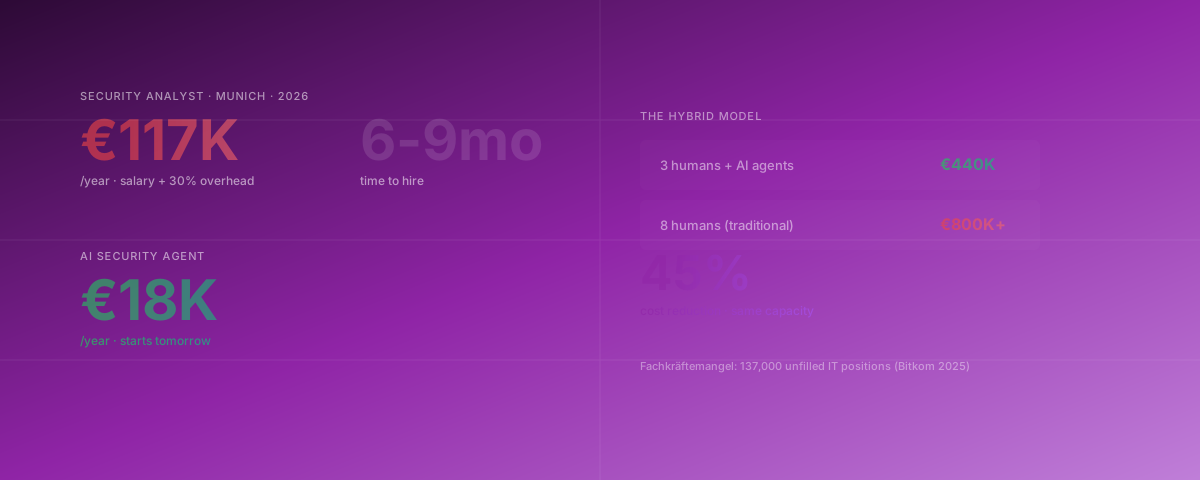
| Annual cost (fully loaded) | €100,000 – €117,000 |
| Time to productivity | 6 months after start date |
| Time to start (with Kündigungsfrist) | 3–6 months after offer |
| Total timeline to value | 9–12 months |
| Year 1 effective cost | €154,000 – €187,000 |
| Capacity | 1 FTE, ~1,800 hours/year |
| Availability | Business hours + on-call rotation |
Option B: Deploy an AI Security Agent
| Factor | AI Security Agent |
|---|---|
| Annual cost | €18,000 (€1,500/month) |
| Time to productivity | Day 1 |
| Time to start | Days to weeks |
| Total timeline to value | Weeks |
| Year 1 effective cost | €18,000 |
| Capacity | Continuous, parallel processing |
| Availability | 24/7/365 |
The cost difference is striking: €18K/year vs €100–117K/year. But the real insight isn’t about replacement — it’s about what each is good at.
This is not a replacement argument. It’s an augmentation argument.
Research consistently shows that 40–45% of SOC analyst tasks are automatable: log correlation, alert triage, IOC enrichment, report compilation, compliance evidence gathering, vendor questionnaire responses.
The remaining 55–60% requires human judgment: threat hunting in ambiguous situations, incident response coordination, stakeholder communication, strategic risk assessment, regulatory interpretation.
An AI agent handles the 40–45% so your human analysts focus on the 55–60% that actually needs their brain.
Your senior analyst isn’t valuable because they can compile a weekly metrics report. They’re valuable because they can look at an anomalous pattern and say, “This looks like lateral movement — we need to isolate that segment now.” Stop paying €117K/year for someone to spend half their time on tasks a machine handles better and faster.
When to Hire vs. When to Deploy Agents
Not everything should be automated. Not everything needs a human. Here’s the decision framework:
| Hire a Human When | Deploy an AI Agent When |
|---|---|
| Security strategy development | Continuous log monitoring & alert triage |
| Stakeholder & board communication | Compliance evidence compilation |
| Crisis leadership & incident command | Report generation (weekly, monthly, quarterly) |
| Regulatory relationship management | Vendor security questionnaire processing |
| Betriebsrat negotiations on security policies | Compliance control checking & gap identification |
| Threat hunting in novel/ambiguous scenarios | IOC enrichment & threat feed correlation |
| Team mentoring & culture building | Policy document drafting from templates |
| Cross-functional security architecture | Vulnerability scan result prioritization |
| Third-party risk assessment (relationship-based) | Repetitive data aggregation across tools |
| Audit interactions requiring professional judgment | Patch compliance tracking & reporting |
The pattern is clear: humans for judgment, relationships, and ambiguity. Agents for volume, repetition, and speed.
If a task involves reading a room, navigating politics, or making a call with incomplete information — that’s human territory. If a task involves processing structured data, checking against known criteria, or producing formatted output — that’s agent territory.
The Hybrid Model: 3 Humans + 5 Agents = 8-Person Output
Here’s where the economics get compelling. Consider two approaches to staffing a security operations function:
| Traditional Model | Hybrid Model | |
|---|---|---|
| Headcount | 8 humans | 3 humans + 5 AI agents |
| Human cost | ~€800,000+/year (fully loaded) | ~€350,000/year (fully loaded) |
| Agent cost | €0 | €90,000/year (5 × €18K) |
| Total cost | €800,000+ | €440,000 |
| Effective output | 8 FTE equivalent | 8 FTE equivalent |
| 24/7 coverage | Requires shift rotation (3+ people) | Agents cover off-hours monitoring |
| Time to scale | 12–18 months | Weeks for agents, months for humans |
| Cost reduction | Baseline | 45% |
€440K vs €800K+ for the same operational output. That’s a 45% cost reduction.
But it’s not just about cost. The hybrid model gives you:
- Speed to capability: Agents deploy in weeks, not months
- 24/7 coverage without shift premiums: Agents don’t need Nachtzuschlag
- Elastic scaling: Need more capacity for audit season? Add agents temporarily
- Human focus: Your 3 analysts work on high-value tasks exclusively
- Reduced burnout: No one’s spending 4 hours a day on log reviews
The three humans in this model aren’t doing the same job as before minus five people. They’re doing a different job — one focused entirely on the work that requires human cognition, creativity, and judgment. They’re more engaged, more effective, and less likely to leave for a company that doesn’t make them do grunt work.
How This Plays Out in Practice
A mid-sized German company (500–2,000 employees) running NIS2 compliance alongside operational security might structure their hybrid team like this:
Human 1: Security Operations Lead Owns incident response, threat hunting, SOC strategy. Manages AI agent outputs, handles escalations, coordinates with IT operations.
Human 2: GRC & Compliance Manager Manages regulatory relationships, leads audit preparation, handles Betriebsrat coordination on security policies, interprets regulatory requirements.
Human 3: Security Architect / Engineer Designs security architecture, evaluates and integrates tools, handles complex technical implementations, mentors junior team members (when you eventually hire them).
Agent 1: SOC Monitoring Agent 24/7 alert triage, log correlation, IOC enrichment, automated initial response playbooks. Escalates to Human 1 when thresholds are met.
Agent 2: Compliance Agent Continuous control monitoring, evidence collection, gap identification, control effectiveness metrics. Feeds structured data to Human 2.
Agent 3: Reporting Agent Generates weekly security metrics, monthly board reports, quarterly compliance summaries, ad-hoc data compilations. All three humans consume its output.
Agent 4: Vendor Risk Agent Processes incoming and outgoing security questionnaires, maintains vendor risk registers, tracks remediation items, flags anomalies for human review.
Agent 5: Vulnerability Management Agent Ingests scan results, prioritizes based on exploit availability and asset criticality, tracks patching SLAs, generates remediation reports for IT operations.
This isn’t theoretical. This is how forward-thinking security teams in Germany are structuring themselves right now.
The Objections (And Why They Don’t Hold)
“AI can’t handle the nuance of German regulatory requirements.”
Correct. That’s why you still have a GRC Manager. The agent handles evidence collection and control checking — the 70% of compliance work that’s mechanical. The human handles interpretation, relationships, and judgment — the 30% that’s genuinely complex.
“What about data privacy? We can’t send sensitive data to AI systems.”
Valid concern, solvable problem. On-premises and EU-hosted AI deployments exist specifically for this. Data classification and processing boundaries are configuration decisions, not architectural blockers.
“The Betriebsrat will never approve AI agents.”
The Betriebsrat cares about Mitbestimmung regarding employee monitoring and working conditions. AI agents that handle security operations tasks — log analysis, report generation, compliance checking — are tools, not surveillance systems. Frame them correctly, involve the Betriebsrat early, and this is a non-issue. They approved your SIEM. They’ll approve your agents.
“We tried automation before. It didn’t work.”
SOAR playbooks circa 2022 are not the same as LLM-powered agents in 2026. The difference is that modern agents handle ambiguity, adapt to novel inputs, and improve with feedback. Previous automation was brittle — if the input didn’t match the expected format, it broke. Agents reason through variations.
The Decision Framework
If you’re a CISO reading this, here’s your next step:
1. Audit your current team’s time allocation. Track where your security staff actually spends their hours for two weeks. You’ll find 40–50% goes to tasks that don’t require human judgment.
2. Identify your highest-pain gaps. Where are you most exposed? What’s not getting done because you don’t have the people? That’s where agents deliver immediate value.
3. Calculate your true cost of hiring. Use the framework above. Be honest about timelines, especially Kündigungsfristen. Compare the 12-month cost of a hire against the 12-month cost of an agent.
4. Start with one agent, one use case. Don’t try to automate everything at once. Pick the highest-volume, most repetitive workflow — usually alert triage or compliance evidence collection — and deploy an agent there. Measure results for 90 days.
5. Scale based on evidence. Once you have data on agent performance, build the business case for the hybrid model. CFOs love 45% cost reductions backed by real numbers.
The Bottom Line
The German cybersecurity talent market in 2026 is defined by scarcity, cost, and time. A single senior security hire costs €154K–€187K in Year 1 and takes 7–15 months to deliver value. Meanwhile, 137,000 IT positions sit unfilled and your attack surface doesn’t wait.
AI agents aren’t replacing your security team. They’re making a team of 3 perform like a team of 8 — at 45% of the cost, with 24/7 coverage, deployed in weeks instead of months.
The CISOs who figure this out first won’t just save budget. They’ll build security programs that actually scale.
See what an AI security agent handles for €1.5K/month.
Stop waiting 12 months for a hire that costs 8× more. Deploy an agent this week.
Need help with this?
We help enterprise security teams implement what you just read — from strategy through AI-powered automation. First strategy session is free.