AI Agent Economics: Why Our Agents Cost €15/mo, Not $300/day
AI Agent Economics: Why Our Agents Cost €15/mo, Not $300/day
On February 18th, 2026, the All-In Podcast published an episode that has now been viewed 2.2 million times.
Jason Calacanis, co-host and long-time tech investor, said this out loud:
“We hit $300/day per agent using the Claude API. That’s $100,000 a year per agent.”
Chamath Palihapitiya didn’t push back. He acknowledged costs are a real and growing problem: “We’re getting to a place where we have to manage this.”
2.2 million people heard that. Every CISO in my network is now asking the same question: “If AI agents cost $100K a year, why wouldn’t I just hire a person?”
It’s a fair question. And it has a simple answer.
Jason’s agents are architecturally broken. Mine aren’t.
The $300/Day Problem Is an Architecture Problem
Before you assume I’m taking shots at Jason Calacanis for sport, let me be precise: his cost numbers are almost certainly accurate for the way most teams build AI agents. The problem is how most teams build AI agents.
Here’s what “$300/day per agent” actually means in practice.
The Brute Force Pattern
Most AI agent implementations follow what I call the brute force pattern:
- Collect everything that might be relevant (logs, tickets, reports, emails)
- Stuff it all into the context window
- Ask the LLM to figure it out
- Pay for every token, every time
This is the equivalent of hiring a consultant and having them read your entire 200-page policies binder before answering a single yes/no question. Every. Single. Query.
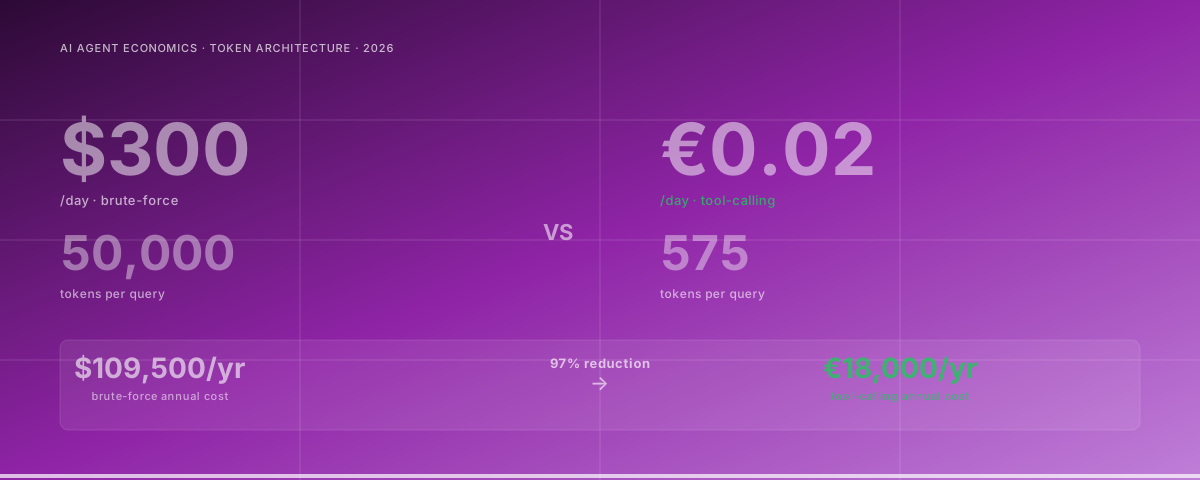
At Claude Sonnet’s current pricing (~$3/million input tokens), a context window stuffed with 50,000 tokens costs roughly $0.15 per query. Run that agent 2,000 times a day (realistic for a production system handling enterprise security events), and you’re at $300/day.
The math is boring. The architecture is the crime.
Why Most Agents Are Built This Way
I’ve been in security for 20 years. The “dump everything into context” pattern happens for the same reason every other architectural shortcut happens: it works in a demo.
In a proof of concept with 10,000 tokens of sample data and 50 test queries a day, the cost is invisible. The agent looks smart. The demo impresses the board. The architecture gets locked in.
Then production hits. Now you have:
- 500,000+ events per day in a real enterprise
- Hundreds of concurrent agent queries
- Persistent agents running 24/7
- Context windows growing as agents accumulate “memory”
The cost compounds. Linearly, sometimes exponentially.
No one goes back and re-architects the agent at that point. They’re too busy defending the budget.
The Three Anti-Patterns Killing AI Agent Economics
1. Context Window Stuffing Feeding raw, unfiltered data into the LLM. 50KB of logs when you need 200 bytes of structured signal. Logs contain noise. Models charge for noise.
2. No Tool-Calling Design
Treating the LLM as a database query engine instead of a reasoning engine. “Read all our vulnerability reports and summarise” is context stuffing. “Call get_open_criticals(asset_group='production', age_days=30) and reason about the results” is tool-calling. The second uses 40× fewer tokens.
3. Stateless Agents with No Memory Architecture Re-feeding context on every query because there’s no structured state. Every query starts from zero. Every query pays full price.
How We Built It Differently
When I designed the Security Factory agents, I had one hard constraint from day one: this has to be operationally affordable for a German Mittelstand company. Not a US venture-backed startup burning VC money. A 1,000-person manufacturing company with a 3-person security team and a realistic IT budget.
That constraint forced good architecture.
The Tool-Calling Architecture
Our agents don’t read. They call functions.
Agent receives query: "What are our highest-risk open findings?"

❌ Brute Force:
→ Load all 17 security files into context
→ Load all 50 risks, 12 incidents, 25 AI tools, 10 vendors
→ ~108KB of context → ~27,000 tokens → $0.08 per query

✅ Tool-Calling:
→ Agent calls: get_risks(status="open", severity=["critical","high"], limit=10)
→ Function returns: 2.3KB typed JSON, 10 filtered records
→ ~575 tokens → $0.0017 per query
→ 98% cheaper. Same answer. Better structured output.
Agent receives natural language or structured request
LLM selects the appropriate typed function from the tool schema — not "read everything"
Function executes against structured data store, returns 2–5KB of exactly relevant records
Model gets only what it needs. Reasoning happens over clean, structured data.
Output is structured, traceable, and cheap — €0.01–0.02 per query total
The Typed Schema Layer
The agents don’t get raw data — they get typed domain objects. When our GRC agent queries the risk register, it doesn’t receive a 50-row CSV dump. It receives:
{
  "risks": [
    {
      "id": "R-042",
      "title": "Unpatched critical CVE in production firewall",
      "severity": "critical",
      "status": "open",
      "owner": "IT-Ops",
      "due_date": "2026-02-28",
      "days_overdue": 12,
      "controls": ["NIST-SI-2", "ISO-8.8"],
      "linked_incidents": ["INC-007"]
    }
  ],
  "total_open_critical": 3,
  "avg_days_overdue": 8.4
}
That’s 340 tokens. Not 8,500 tokens. The LLM reasons over structured signal, not raw documentation.
Structured State, Not Context Replay
Our agents maintain a lightweight structured state object that persists between queries. When the board asks the same agent a follow-up question 10 minutes later, it doesn’t re-query everything — it already knows the current risk posture. The state costs a few hundred tokens to carry. It eliminates thousands.
The Token Economics, Broken Down
Let me show you exactly what our agents cost to run.
Brute Force Agent
- Context per query: ~50,000 tokens
- Queries per day: 2,000
- Daily tokens: 100M
- Cost at $3/M input tokens: $300/day
- Monthly: $9,000
- Annual: $109,500
Tool-Calling Agent (Security Factory)
- Context per query: ~2,000–5,000 tokens
- Queries per day: 500 (agents are efficient, not brute)
- Daily tokens: 1–2.5M
- Cost at €3/M input tokens: €3–7/day
- Monthly: €90–210 (API cost)
- Infrastructure: €15–30/mo per agent
- Annual API + infra: ~€1,500–2,900
We charge €1,500/month per agent. The API and infrastructure costs us €15–30/month. That’s a 97–99% margin — but more importantly, it’s a €18,000/year per agent to the customer, not $100,000.
And for that €18K, the agent runs 24 hours a day, 365 days a year, never calls in sick, never needs a notice period, and never costs you 3-6 months of Kündigungsfrist when it doesn’t work out.
The Elephant in the Room: Why Not Just Hire a Human?
The All-In question is legitimate. Rephrased: “If enterprise AI agents cost $100K/year, why not hire a junior analyst for the same money?”
The answer, if you’re using well-architected agents, is that you don’t have to choose — because your agents don’t cost $100K.
But let me address the comparison anyway, because it comes up in every CISO conversation I have.
The honest comparison isn’t “AI agent vs. human analyst.” It’s:
What does a human cost?
- Year 1 fully loaded: €85–95K
- Ongoing: €80–90K/year
- Available: 8h/day, 220 days/year (excludes vacation, sick days, meetings)
- Scope: One specialisation (GRC or incident response or vendor management — not all three)
- Notice period: 3–6 months if it’s not working
- Ramp time: 3–6 months before they’re effective
What does a Security Factory agent cost?
- Year 1: €18K (€1,500/mo × 12)
- Ongoing: €18K/year flat (no salary inflation, no benefit increases)
- Available: 24h/day, 365 days/year
- Scope: Full GRC stack — risk register, compliance mapping, board briefings, vendor assessments, incident linkage
- Notice period: Cancel subscription. Done.
- Ramp time: Minutes (it already knows NIS2, ISO 27001, NIST, BSI Grundschutz)
You still need human judgment at the top. CISOs aren’t going anywhere. But the 6 hours a junior analyst spends pulling together a board briefing? That’s gone. The 3 days a senior GRC manager spends processing a 50-risk register? Gone. 8 seconds.
Why Structured Data Beats Context Dumps — Every Time
Here’s the deeper architectural argument, beyond cost.
When you stuff a 50-page risk register into a context window and ask “what are our top risks?”, the model has to do two things simultaneously: parse structure AND reason about content. That’s expensive computationally (hence the token costs) and more importantly, it’s fragile. Model outputs vary based on how the document happens to be formatted, what comes first in the context, and what gets cut off at the token limit.
When you call get_risks(severity='critical', status='open') and the model reasons over 10 structured records, it only has to reason. The structure is already done. The output is deterministic, traceable, and auditable.
For security applications — where a CISO needs to defend decisions to a Vorstand or a NIS2 auditor — traceability is non-negotiable. “The AI said so” is not an audit trail. “The agent called get_risks(), received these 10 records, and flagged R-042 because it’s 12 days overdue and linked to INC-007” is an audit trail.
The Security Factory Pricing Model — Transparent, Flat, Predictable
We don’t do usage-based pricing that scales into $300/day surprises. We charge flat monthly per agent.
Per Agent: €1,500/month
- Unlimited queries within operational parameters
- All framework mappings included (NIST, ISO 27001, BSI, NIS2, DORA, EU AI Act)
- Structured state persistence
- Full audit log
- API included — no hidden costs
Full Security Factory Platform: €18,000–25,000/month
- 14 coordinated agents covering the full security operations stack
- Replaces capacity of 8-person security team for GRC and compliance functions
- EU data sovereignty: German-hosted infrastructure, GDPR-compliant, no US data transfer
For context: 8 Munich security analysts cost €640,000–760,000 per year in fully-loaded salary. Our full platform costs €216,000–300,000 per year. The math isn’t close.
What To Do Next
The All-In conversation is useful — it proves that AI agents are no longer theoretical. Fortune 500 companies are deploying them. The question isn’t whether to use AI agents. The question is whether you’re building them right.
If you want to see the architecture in practice, our demo runs live on dig8ital.com. MusterSec is a fictional 1,000-person company with 17 interconnected security files: 50 risks, 12 incidents, 25 shadow AI tools, 10 vendors. The GRC agent processes the entire risk register and delivers a board briefing in under 15 seconds.
That demo costs us approximately €0.02 to run. Every time.
→ Try the Security Factory demo agents
→ Book a 30-minute architecture walkthrough
If you’re currently evaluating AI agent platforms and getting quotes that look like Jason’s $100K/year number — get a second opinion. The cost isn’t in the technology. It’s in the architecture. And architecture is fixable.
Next: Shadow AI Audit — Finding the 25 AI Tools Your Employees Already Use
Questions? Reach us at hello@dig8ital.com or connect with Alex on LinkedIn.
Need help with this?
We help enterprise security teams implement what you just read — from strategy through AI-powered automation. First strategy session is free.