The 8-Person Security Team Playbook: What AI Agents Actually Handle vs What Still Needs Humans
Your Team Is Doing 20 People’s Work. Everyone Knows It. No One Says It.
Here’s the math no one puts on a slide: a mid-market security team of 8 people — the kind you find at a €200M–€2B German Mittelstand company — is responsible for roughly 400 hours of work every week. They have 320 hours available. The remaining 80+ hours? They vanish into overtime, shortcuts, and tasks that simply don’t get done.
The talent market won’t save you. Germany had 149,000 unfilled IT positions in 2025, with security specialists among the hardest roles to fill. Even if you find someone, a senior SOC analyst costs €85K–€110K fully loaded — and takes 6 months to become productive in your environment. Your CFO already told you: headcount is frozen, figure it out with AI.
Fine. But “figure it out with AI” is meaningless without knowing which tasks AI can actually handle, which ones it can accelerate, and which ones still need a human brain. This article maps every single one.
The Weekly Task Map: What 8 People Actually Do
We mapped the weekly workload across 8 standard roles in a mid-market security team. These hours reflect real operational demands — not job descriptions, not theory. What actually needs to happen for the organization to maintain a defensible security posture aligned with NIST CSF and ISO 27001.
1. CISO — Chief Information Security Officer
| Task | Hours/Week |
|---|---|
| Board & executive reporting preparation | 6 |
| Security strategy & roadmap updates | 5 |
| Stakeholder meetings (IT, Legal, HR, OT) | 8 |
| Budget planning & vendor negotiations | 4 |
| Incident escalation & crisis management | 3 |
| Regulatory landscape monitoring (NIS2, DORA) | 3 |
| Team leadership & 1:1s | 4 |
| Risk appetite & acceptance decisions | 3 |
| Subtotal | 36 |
2. GRC Manager — Governance, Risk & Compliance
| Task | Hours/Week |
|---|---|
| Risk register maintenance & updates | 8 |
| Compliance control mapping (ISO 27001, TISAX) | 6 |
| Audit preparation & evidence collection | 7 |
| Policy drafting & review cycles | 5 |
| Third-party risk assessments | 6 |
| KPI/KRI reporting | 4 |
| Management review documentation | 3 |
| Exception & waiver tracking | 3 |
| Subtotal | 42 |
3. Security Architect
| Task | Hours/Week |
|---|---|
| Cloud security architecture reviews (AWS/Azure) | 8 |
| Network segmentation & firewall rule reviews | 6 |
| Architecture decision records & documentation | 5 |
| Zero Trust implementation planning | 4 |
| Technology evaluation & PoC coordination | 5 |
| Threat modeling for new projects | 6 |
| Infrastructure-as-Code security reviews | 4 |
| OT/IT convergence security design | 4 |
| Subtotal | 42 |
4. SOC Analyst — Senior (L2/L3)
| Task | Hours/Week |
|---|---|
| SIEM alert investigation & correlation | 10 |
| Incident response & containment | 8 |
| Threat hunting (proactive) | 6 |
| Detection rule tuning & creation | 5 |
| Threat intelligence analysis | 4 |
| Forensic analysis & evidence preservation | 5 |
| Playbook development & refinement | 4 |
| SOC metrics & shift reporting | 3 |
| Subtotal | 45 |
5. SOC Analyst — Junior (L1/L2)
| Task | Hours/Week |
|---|---|
| Alert triage & initial classification | 15 |
| L1 ticket handling & documentation | 8 |
| Phishing email analysis & response | 6 |
| IOC lookup & enrichment | 5 |
| Escalation to L2/L3 | 3 |
| Dashboard monitoring | 8 |
| Log source health checks | 3 |
| Subtotal | 48 |
6. AppSec Engineer
| Task | Hours/Week |
|---|---|
| SAST/DAST scan management & triage | 8 |
| Secure code review (manual) | 10 |
| DevSecOps pipeline maintenance | 5 |
| Developer security training & support | 4 |
| Vulnerability disclosure management | 3 |
| API security assessments | 5 |
| Container & dependency scanning | 4 |
| Secure SDLC process enforcement | 3 |
| Subtotal | 42 |
7. IT Security Admin
| Task | Hours/Week |
|---|---|
| Endpoint security management (EDR/AV) | 8 |
| IAM & access provisioning/deprovisioning | 7 |
| Patch management & deployment | 8 |
| Certificate & secret management | 4 |
| Backup verification & DR testing | 4 |
| Vulnerability scan execution & tracking | 6 |
| Firewall & proxy administration | 5 |
| Asset inventory maintenance | 4 |
| Subtotal | 46 |
8. Compliance Officer
| Task | Hours/Week |
|---|---|
| NIS2 compliance tracking & gap analysis | 8 |
| GDPR/DSGVO data protection coordination | 6 |
| TISAX assessment management | 5 |
| Policy lifecycle management | 5 |
| Security awareness training coordination | 4 |
| Vendor compliance verification | 6 |
| Regulatory change monitoring | 4 |
| Incident notification & reporting obligations | 3 |
| Subtotal | 41 |
102 hours per week. That’s 2.5 full-time employees worth of work that doesn’t exist. Every week, your team decides — consciously or not — what doesn’t get done.
The AI Agent Mapping: What Can Actually Be Automated
Not everything labeled “AI” is the same. We classify each task into three categories based on what current-generation AI agents — not chatbots, not copilots, but autonomous agents with tool access — can reliably handle.
🟢 Fully Automatable — Agent Handles End-to-End
These tasks follow predictable patterns, have clear inputs/outputs, and don’t require judgment calls that depend on organizational context.
| Task | Role | Hours/Week | What the Agent Does |
|---|---|---|---|
| Risk register updates | GRC Manager | 5 | Ingests scan results, maps to risk entries, updates likelihood/impact scores, flags changes |
| Compliance control evidence collection | GRC Manager | 4 | Pulls configs, screenshots, logs against control requirements automatically |
| Alert triage & initial classification | SOC Junior | 15 | Correlates alerts with threat intel, enriches with context, classifies severity, auto-closes false positives |
| IOC lookup & enrichment | SOC Junior | 5 | Queries VirusTotal, AbuseIPDB, MISP, enriches tickets automatically |
| Dashboard monitoring | SOC Junior | 8 | Continuous monitoring with anomaly detection, alerts humans only on deviations |
| Certificate & secret management | IT Sec Admin | 4 | Monitors expiry, auto-renews where possible, alerts 30/14/7 days before expiry |
| Log source health checks | SOC Junior | 3 | Monitors ingestion rates, alerts on gaps or anomalies |
| SAST/DAST scan management & triage | AppSec | 5 | Runs scans on schedule, deduplicates findings, auto-triages known false positives |
| Asset inventory maintenance | IT Sec Admin | 4 | Discovers assets via network scans, reconciles with CMDB, flags discrepancies |
| Regulatory change monitoring | Compliance | 4 | Monitors BSI, ENISA, EU publications; summarizes changes; maps to existing controls |
| Vulnerability scan execution | IT Sec Admin | 4 | Scheduled scans, result parsing, ticket creation, SLA tracking |
| Policy review scheduling | Compliance | 2 | Tracks review dates, sends reminders, escalates overdue policies |
| KPI/KRI reporting | GRC Manager | 4 | Aggregates metrics from tools, generates dashboards and reports |
| Exception & waiver tracking | GRC Manager | 3 | Monitors expiry, sends renewal reminders, tracks approval workflows |
| Phishing email analysis | SOC Junior | 4 | Header analysis, URL detonation, attachment sandboxing, auto-response for known patterns |
| Vendor questionnaire distribution | GRC Manager | 2 | Sends, tracks, reminds, collects completed questionnaires |
Total: ~76 hours/week fully automated
🟡 AI-Assisted — Agent Does 80%, Human Reviews
These tasks benefit massively from AI doing the heavy lifting, but require human judgment for final decisions, context-dependent interpretation, or stakeholder communication.
| Task | Role | Hours/Week | What Changes |
|---|---|---|---|
| Board reporting preparation | CISO | 6 | Agent drafts the briefing from metrics, KRIs, incidents. CISO reviews and adds narrative. Saves 4h. |
| Incident response & containment | SOC Senior | 8 | Agent auto-contains (isolate host, block IP), assembles timeline. Analyst validates and decides next steps. Saves 4h. |
| Threat intelligence analysis | SOC Senior | 4 | Agent correlates feeds, maps to MITRE ATT&CK, produces summary. Analyst interprets relevance. Saves 2h. |
| Compliance control mapping | GRC Manager | 6 | Agent maps controls across frameworks (ISO→NIS2→TISAX). GRC Manager validates edge cases. Saves 4h. |
| Architecture review checklists | Sec Architect | 4 | Agent pre-populates review against baseline, flags deviations. Architect makes design decisions. Saves 2h. |
| Access reviews & recertification | IT Sec Admin | 7 | Agent pulls access lists, flags anomalies (orphaned accounts, privilege creep), drafts recommendations. Admin approves. Saves 5h. |
| Audit preparation | GRC Manager | 7 | Agent assembles evidence packages, maps to audit criteria, identifies gaps. GRC Manager fills gaps and presents. Saves 4h. |
| Detection rule tuning | SOC Senior | 5 | Agent analyzes false positive rates, suggests threshold adjustments. Analyst validates and deploys. Saves 3h. |
| Policy drafting & review | GRC Manager | 5 | Agent generates policy drafts from templates and regulatory requirements. GRC Manager adapts to organizational context. Saves 3h. |
| Secure code review | AppSec | 10 | Agent pre-reviews with semantic analysis, flags high-confidence issues. Engineer focuses on complex logic and business context. Saves 5h. |
| Patch management | IT Sec Admin | 8 | Agent prioritizes by CVSS + exploitability + asset criticality, generates deployment plan. Admin validates compatibility and schedules. Saves 4h. |
| Third-party risk assessments | GRC Manager | 6 | Agent scores vendors from questionnaire responses, public data, breach history. GRC Manager reviews borderline cases. Saves 3h. |
| NIS2 gap analysis | Compliance | 8 | Agent maps current controls to NIS2 requirements, identifies gaps, drafts remediation plan. Compliance Officer validates and prioritizes. Saves 5h. |
| SIEM alert investigation | SOC Senior | 10 | Agent performs initial correlation, enrichment, and timeline assembly. Senior analyst focuses on complex multi-stage attacks. Saves 5h. |
| Container & dependency scanning | AppSec | 4 | Agent scans, deduplicates, prioritizes by reachability. Engineer reviews critical findings. Saves 2h. |
| Vendor compliance verification | Compliance | 6 | Agent checks certifications, monitors for changes, flags expirations. Officer handles exceptions. Saves 4h. |
| Vulnerability tracking | IT Sec Admin | 2 | Agent tracks remediation SLAs, escalates overdue items. Admin handles blockers. Saves 1h. |
Total: ~106 hours/week AI-assisted → saves ~60 hours of human effort
🔴 Human Required — No Substitution
These tasks require judgment, creativity, relationships, or authority that AI cannot replicate.
| Task | Role | Hours/Week | Why |
|---|---|---|---|
| Security strategy & roadmap | CISO | 5 | Requires business context, political awareness, risk appetite interpretation |
| Stakeholder meetings | CISO | 8 | Relationship building, negotiation, reading the room |
| Budget & vendor negotiations | CISO | 4 | Commercial judgment, negotiation leverage, organizational politics |
| Incident escalation & crisis leadership | CISO | 3 | Authority, decision-making under pressure, communication |
| Risk appetite & acceptance decisions | CISO | 3 | Board-level judgment, liability awareness |
| Team leadership & 1:1s | CISO | 4 | People management, career development, motivation |
| Zero Trust implementation planning | Sec Architect | 4 | Organizational change management, stakeholder buy-in |
| Technology evaluation & PoC | Sec Architect | 5 | Hands-on testing, vendor relationship, integration judgment |
| Threat modeling for new projects | Sec Architect | 6 | Creative adversarial thinking, business logic understanding |
| OT/IT convergence design | Sec Architect | 4 | Physical-digital intersection, safety considerations, plant-floor politics |
| Network segmentation reviews | Sec Architect | 6 | Environmental knowledge, legacy system constraints |
| Playbook development | SOC Senior | 4 | Operational experience, edge case handling |
| Forensic analysis | SOC Senior | 5 | Chain of custody, legal requirements, expert judgment |
| Threat hunting (proactive) | SOC Senior | 6 | Hypothesis-driven, creative, requires attacker mindset |
| SOC metrics & reporting | SOC Senior | 3 | Narrative interpretation, improvement recommendations |
| Manual secure code review (complex) | AppSec | 5 | Business logic flaws, architectural issues |
| Developer training & support | AppSec | 4 | Teaching, mentoring, building security culture |
| DevSecOps pipeline design | AppSec | 5 | Integration decisions, developer experience trade-offs |
| API security assessments | AppSec | 5 | Business logic, authorization model understanding |
| Vulnerability disclosure mgmt | AppSec | 3 | External communication, coordination, legal |
| Firewall & proxy administration | IT Sec Admin | 5 | Change management, impact assessment |
| Backup & DR testing | IT Sec Admin | 4 | Physical verification, recovery validation |
| GDPR/DSGVO coordination | Compliance | 6 | Legal interpretation, DPO interaction, Betriebsrat coordination |
| TISAX assessment management | Compliance | 5 | Assessor interaction, evidence presentation, scope negotiation |
| Security awareness training | Compliance | 4 | Content relevance, culture building, engagement |
| Incident notification obligations | Compliance | 3 | Legal timing requirements, authority communication, liability |
| Management review documentation | GRC Manager | 3 | Contextual narrative, strategic recommendations |
| Escalation decisions | SOC Junior | 3 | Judgment calls on borderline alerts |
| IaC security reviews | Sec Architect | 4 | Architecture decisions, drift interpretation |
Total: ~131 hours/week — stays with humans
The Numbers That Matter
Here’s what that means in practice:
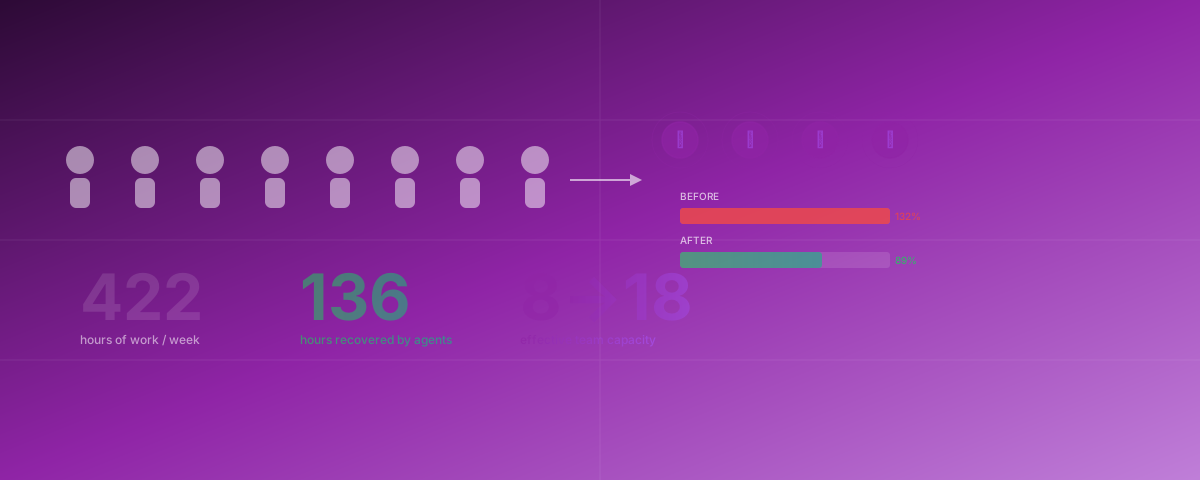
- Before AI agents: 422 hours of work, 320 hours of capacity. Deficit: 102 hours. Team runs at 132% load.
- After AI agents: 422 - 136 = 286 hours of remaining human work, 320 hours of capacity. Surplus: 34 hours. Team runs at 89% load.
That surplus is not waste. It’s the buffer your team needs to actually do threat hunting instead of just talking about it. To review policies before the auditor asks. To run a tabletop exercise. To think.
The effective capacity math: 8 humans producing 320 hours of high-value work + AI agents handling 136 hours autonomously = output equivalent of 18–20 people. Without a single new hire.
What Actually Stops Getting Done (And Why Attackers Love It)
When your team runs at 132% capacity, they don’t do everything badly. They do some things well and silently drop others. These are the tasks that fall off first — and they’re exactly the gaps attackers exploit.
Vendor risk assessments go overdue. The questionnaires sit in a shared inbox. The GRC Manager means to follow up but there’s an audit next week. Six months later, a supplier gets breached and you discover their last assessment was from 2024. NIS2 Article 21(2)(d) requires supply chain security. You’re non-compliant and exposed.
Policies aren’t reviewed. ISO 27001 Clause 7.5 requires documented information to be reviewed at planned intervals. Your Acceptable Use Policy hasn’t been updated since pre-COVID. Your remote work policy doesn’t mention AI tools. The auditor notices.
Access reviews are rubber-stamped. The IAM team sends the spreadsheet. Managers click “approve all” because they don’t have time to review 200 line items. Three former contractors still have VPN access. An intern from last summer still has access to the CI/CD pipeline.
Training metrics aren’t tracked. You run phishing simulations quarterly — when you remember. Click rates? Repeat offenders? Department-level trends? Nobody’s looking. NIS2 Article 20 requires management body training. You can’t prove it happened.
OT security is “someone else’s problem.” The plant floor runs a SCADA system from 2019. IT Security knows it’s there. OT Engineering says don’t touch it. Nobody owns the risk. The asset isn’t even in your inventory.
Threat hunting doesn’t happen. Your SOC Senior has “proactive threat hunting” on their job description. In practice, they spend those hours on alert backlog and incident follow-up. Dwell time increases. You find breaches when the attacker tells you, not when your team detects them.
Every one of these gaps is addressable with AI agents — not by replacing the human decision, but by ensuring the task actually gets initiated, tracked, and escalated instead of silently disappearing from the queue.
Implementation Path: 4 Phases to Full Coverage
Don’t try to automate everything at once. Start where the return is highest and the risk is lowest.
Phase 1 — Weeks 1–2: GRC & Compliance Agents
Hours recovered: ~45/week
Deploy agents for risk register maintenance, compliance control evidence collection, policy review scheduling, KPI/KRI reporting, and regulatory change monitoring. These tasks are high-volume, low-risk, and immediately measurable. Your GRC Manager gets 15+ hours back per week — nearly two full days.
Why first: GRC tasks are document-centric with clear success criteria. If the agent produces a wrong risk score, a human catches it in review. No production systems are touched.
Phase 2 — Months 1–2: Vendor Risk & AI Governance Agents
Hours recovered: ~25/week
Add vendor questionnaire distribution and tracking, third-party risk scoring, vendor compliance monitoring, and exception/waiver tracking. Layer in AI governance controls for the agents themselves — audit trails, decision logging, bias monitoring.
Why second: Vendor risk is where most teams accumulate silent debt. Automating the distribution-and-chase cycle alone recovers significant hours while reducing supply chain risk exposure under NIS2.
Phase 3 — Months 3–4: Vulnerability & Incident Response Agents
Hours recovered: ~40/week
Deploy alert triage automation, IOC enrichment, phishing analysis, vulnerability scan orchestration, patch prioritization, and certificate monitoring. These touch production-adjacent systems, so proper guardrails and containment policies are essential.
Why third: SOC and vulnerability management automation has the highest impact but also the highest consequence of errors. By this phase, your team has experience working with agents and trusts the review workflow.
Phase 4 — Month 6+: Full Agent Factory
Hours recovered: ~26/week (remaining tasks)
All automatable tasks operational. AI-assisted workflows refined based on 4+ months of production data. Agent performance metrics established. Continuous improvement cycle running. Your team operates at 89% capacity with room for strategic work, innovation, and the unexpected.
Why last: The remaining tasks require fine-tuning based on your specific environment. Board reporting agents need to learn your CISO's voice. Architecture review agents need your technology stack context. This takes time and iteration.
The Bottom Line
Your 8-person team isn’t failing. They’re doing heroic work under impossible conditions. The answer isn’t motivation, process optimization, or another RACI matrix. The answer is giving them autonomous systems that handle the 136 hours of work that shouldn’t require a human brain in the first place.
This isn’t about replacing your team. It’s about letting them do the work they were hired for — the strategic, creative, relationship-driven work that actually moves your security posture forward. The work that makes the difference between “we have a compliance program” and “we have a security program.”
The math is simple. The implementation is straightforward. The hardest part is starting.
See what the GRC agent produces with sample data from a realistic German manufacturer → Try the demo
Need help with this?
We help enterprise security teams implement what you just read — from strategy through AI-powered automation. First strategy session is free.